Your chronic patients, even between visits

RitmioT brings together, in a single chart, what the patient measures with a ring or watch, the test results they bring on paper or as PDFs, and what they report before the visit. You see how they are evolving, get prioritized alerts and an assessment that cites the guidelines. The decision is yours.

The demo uses a fictitious patient, opens in your browser and changes no data. The platform interface is currently in Spanish.

RitmioT chart of a patient's heart rate and oxygen saturation over one week, separated into sleep, rest and activity.
Sleep 7 h · SpO₂ 96%Gómez, José · no readings below 92%
  • Developed in Tucumán, Argentina, with cardiologists
  • Patent application filed with Argentina's INPI
  • Our own servers in Argentina
  • Every access audited (Argentine Law 25.326)

Between appointments, the patient is out of sight

Heart failure, hypertension and atrial fibrillation decompensate silently. Often the first warning is an emergency room visit. And when the patient arrives, they bring a folder of test results that has to be read and transcribed within the same appointment.

RitmioT covers both gaps: what happens at home between visits, and the paperwork that eats up the visit.

In the office, physicians spend 49.2% of their time on the electronic health record and desk work, and 27.0% face to face with the patient.

Sinsky C, et al. Ann Intern Med. 2016;165(11):753-60. Time-and-motion study in 4 specialties.
Between two visits, continuous follow-up reveals a decompensation that the quarterly visit does not see. alert: activity drops, resting HR rises Visit Visit month 0 month 3
What you see with quarterly check-ups What you see with continuous follow-up

One patient in RitmioT, end to end

Thirty seconds inside the platform, as a physician uses it: medical record, out-of-range values, ring metrics, trends and ECG.

The patient in the video, José Gómez, is fictitious: the data shown was invented for the demonstration and corresponds to no real person. The interface appears in Spanish.

Continuous monitoring with consumer devices the patient can own

The ring or watch sends heart rate, oxygen saturation, steps and sleep through the patient's phone, in the background. RitmioT separates sleep, rest and activity, so 87 bpm while walking is not read the same as 87 bpm at three in the morning.

  • A green, yellow and red status light per patient, and an alert center: no report, low battery, values outside thresholds.
  • Trends from 30 days to one year, with a seven-day projection and the guideline target on every chart.
  • Symptom self-reporting from the app, and export to PDF or CSV.
30-day trends: resting heart rate, average and nighttime oxygen saturation, steps per day, each with its seven-day projection.
Trends by linear regression. The projection is statistical and indicative; it is not a diagnostic prediction.

On-demand ECG when the rhythm doesn't add up

The watch records a single-lead, thirty-second tracing. RitmioT checks the regularity of the RR intervals and the P wave, flags a tracing compatible with atrial fibrillation and leaves it for you to confirm.

RitmioT does not diagnose. It flags a pattern and asks for medical confirmation. It is a single-lead screening: it does not replace a 12-lead ECG.

30-second ECG tracing flagged as possible atrial fibrillation: irregularly irregular RR with no discernible P wave.

The medical record builds itself from what the patient brings

The patient or the front desk uploads the PDF or a photo of the test. The AI extracts each value with its date and unit, places it in the patient's series and you approve what goes in. Years of lab work end up in one table per system, with the current value, the previous one and the trend.

  • Out-of-range values on top, each with its curve.
  • Derived values calculated automatically (BMI, body surface area, HOMA-IR, indexed ventricular mass) and a comparison tool for up to five variables over time.
  • Cross-checked drug interactions across the active medication.
Studies and lab results grouped by specialty, with weight and BMI evolution since 2019.
Out-of-range value cards: blood glucose, glycated hemoglobin, urea and BMI, each with a mini-curve.

A clinical assessment tailored to each patient

The AI reads the full record (diagnoses, medication, lab work, visit notes) together with the clinical guidelines, and returns a summary by area based on the patient's actual conditions, not a one-size-fits-all cardiology template.

  • Free-form questions about the patient, with each answer citing the record data it relies on.
  • PDF of the assessment, and e-consult with a colleague through a link that expires in 24 hours.
  • If the record changes, the assessment tells you it is out of date.

It supports your decision: you review it, correct it or discard it. Nothing enters the record without your approval.

AI-generated clinical assessment for a 68-year-old man with cardio-renal-metabolic syndrome, with a general summary and a comment per area.

The first visit starts before the patient arrives

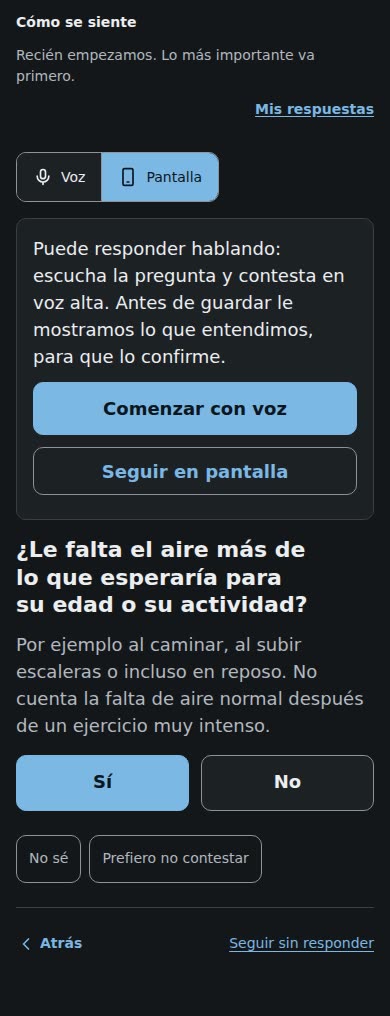
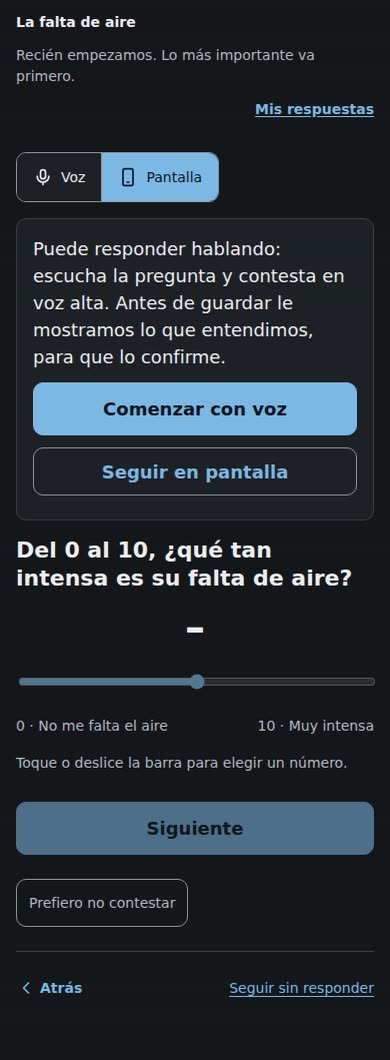
The front desk sends a health questionnaire by WhatsApp that the patient completes on their phone: one question per screen, with a voice that reads each question aloud and the option to answer by speaking. It adapts to the answers: if the patient reports shortness of breath, it digs deeper; if not, it moves on.

You receive an organized summary, with alerts on top and unanswered items marked. The questionnaire was designed with cardiologists, based on a first-visit questionnaire already in use.

Question on the phone, shown in Spanish: “Are you more short of breath than you would expect for your age or activity?”, with the option to answer by voice.
Question with a 0 to 10 scale on the patient's phone.

Built for the whole practice

  • Front desk with its own login

    Registers patients, sends the questionnaire and uploads test results. Sees each patient's status, never the clinical data.

  • E-consult by link

    Shares the assessment with another physician without creating an account for them; the link expires in 24 hours.

  • Any specialty

    Cardiology, diabetes care, nephrology, pulmonology. The chart adapts to the patient's conditions.

  • Interoperable

    Exports in FHIR, the international standard for exchanging clinical data, as well as PDF and CSV.

Front desk inbox showing the first-visit questionnaire status of each patient: not sent, sent, in progress and complete.
Front desk inbox: who has already completed the questionnaire and who needs a reminder.

A day of monitoring, in thirty seconds

Three fictitious patients. Watch the day unfold, and what happens when an irregular rhythm appears during the night.

Simulation with sample data


    --bpm --% SpO₂ 0steps

    30 s ECG requested from the watch · irregularly irregular RR, no P wave: pattern compatible with atrial fibrillation. Requires medical confirmation.

      What the evidence says

      RitmioT has not yet been evaluated in a clinical trial of its own. What has been studied is remote monitoring with clinical response, the category it implements. Here are the figures, with their sources, including the one that does not favor it.

      1. IIb · BESC 2021 Guidelines, heart failure

        Recommended by the European guideline

        Non-invasive home telemonitoring may be considered in patients with heart failure to reduce the risk of readmission and cardiovascular death.

        McDonagh TA, et al. 2021 ESC Guidelines for the diagnosis and treatment of acute and chronic heart failure. Eur Heart J. 2021;42(36):3599-726. doi:10.1093/eurheartj/ehab368

      2. OR 0.78first HF hospitalization

        Fewer hospitalizations and lower mortality

        Meta-analysis of 41 randomized trials and 16,312 patients with heart failure: fewer first HF hospitalizations (OR 0.78; 95% CI 0.70-0.87) and lower all-cause mortality (OR 0.81; 0.69-0.95).

        De Lathauwer I, et al. Remote patient monitoring in heart failure: a comprehensive meta-analysis of effective programme components for hospitalization and mortality reduction. Eur J Heart Fail. 2025;27(9):1670-85. doi:10.1002/ejhf.3568

      3. OR 0.63programs with self-care

        It works when the patient takes part

        In the same meta-analysis, programs with a self-care module (OR 0.63) and an educational module (OR 0.69) are the ones that most reduce HF hospitalization. That is why RitmioT includes symptom self-reporting and care instructions for the patient.

        De Lathauwer I, et al. Eur J Heart Fail. 2025;27(9):1670-85.

      4. HR 0.70all-cause mortality

        A large trial with monitoring and medical response

        TIM-HF2, 1,571 patients: lower all-cause mortality (HR 0.70; 95% CI 0.50-0.96) and fewer days lost to unplanned cardiovascular hospitalization or death (17.8 versus 24.2 days per year). Cardiovascular mortality did not reach significance (p = 0.056).

        Koehler F, et al. Efficacy of telemedical interventional management in patients with heart failure (TIM-HF2). Lancet. 2018;392(10152):1047-57. doi:10.1016/S0140-6736(18)31880-4

      5. 6.5 daysmedian lead time

        Decompensation can be seen coming

        LINK-HF, 100 patients with continuous monitoring after a hospitalization for HF: the alert preceded readmission by a median of 6.5 days, with sensitivity of 76 to 88% and specificity of 85%. It used a multisensor chest patch, not a ring.

        Stehlik J, et al. Continuous wearable monitoring analytics predict heart failure hospitalization: the LINK-HF multicenter study. Circ Heart Fail. 2020;13(3):e006513. doi:10.1161/CIRCHEARTFAILURE.119.006513

      6. 95% · 97%sensitivity · specificity

        Watches detect atrial fibrillation

        Meta-analysis of 26 studies and 17,349 patients: sensitivity of 95% and specificity of 97% for AF. In the general population, with lower prevalence, there are more false positives; that is why RitmioT asks for ECG confirmation.

        Barrera N, et al. Accuracy of smartwatches in the detection of atrial fibrillation: a systematic review and diagnostic meta-analysis. JACC Adv. 2025;4:102133. doi:10.1016/j.jacadv.2025.102133

      7. 66.3 → 40.2%uncontrolled hypertension

        Hypertension

        Retrospective cohort of 6,595 patients: uncontrolled hypertension fell from 66.3% to 40.2% after 90 days of monitoring, and systolic pressure by 7.3 mmHg on average (16.7 mmHg in stage 2). It is an association, with no control group.

        Smith W, et al. Remote patient monitoring is associated with improved outcomes in hypertension: a large, retrospective, cohort analysis. Healthcare (Basel). 2024;12(16):1583. doi:10.3390/healthcare12161583

      8. HR 1.03180-day readmission

        And what came out neutral

        BEAT-HF, 1,437 patients: telemonitoring did not reduce 180-day readmissions, and about half of the patients adhered to the monitoring. The lesson is adherence. In RitmioT the ring transmits on its own and the patient gets something in return: their instructions and their questionnaire.

        Ong MK, et al. Effectiveness of remote patient monitoring after discharge of hospitalized patients with heart failure: the BEAT-HF randomized clinical trial. JAMA Intern Med. 2016;176(3):310-8. doi:10.1001/jamainternmed.2015.7712

      The figures correspond to remote monitoring programs studied in other settings, not to RitmioT. They are cited to show what supports the category and which components explain the effect.

      Clinical data, treated as clinical data

      Your patients' information stays on our own servers in Argentina, with role-based access and a log of every access.

      • Encrypted connection

        The web platform works over HTTPS only, with a valid certificate.

      • Audit of every access

        Who opened which chart and when, including rejected attempts.

      • Everyone sees their own

        Physicians, front desk and patients have different permissions. The front desk never sees diagnoses, test results or assessments.

      • Argentine legal framework

        Designed around Law 25.326 on personal data protection and Law 26.529 on patient rights.

      Getting started takes an afternoon

      1. Walk through the demo

        A complete fictitious patient, read-only, from your browser. Nothing to install.

      2. Let's talk for half an hour

        We look at how your practice works and which patients are best to follow first.

      3. Start with five patients

        A guided trial with five of your chronic patients, with no setup fee. You assess the value before adding more.

      Or write to us at info@ritmiot.com.ar and we'll set up a time.

      Frequently asked questions

      Do I have to buy equipment?

      No. The patient uses their phone and a compatible consumer ring or watch. There are no proprietary kits and no equipment for the practice.

      Is it a medical device?

      No. RitmioT is a clinical decision support tool used under medical supervision: it does not diagnose or replace your judgment. As of today it is not registered as a medical device, either with ANMAT in Argentina or with any other regulator.

      Which specialties is it for?

      The medical record and test reading work for any specialty. Remote monitoring is designed mainly for chronic cardiovascular and metabolic patients: heart failure, hypertension, atrial fibrillation, diabetes.

      Where is the data stored?

      On our own servers in Argentina. To read test results and generate assessments, RitmioT uses an artificial intelligence provider with servers in the United States, which receives only the information needed for that task.

      Does it work on Android and iPhone?

      Yes, there is an app for both. The patient pairs the ring or watch once and the app transmits in the background.

      Does it integrate with the system I already use?

      RitmioT exports in FHIR, the international standard for exchanging clinical data, and in PDF and CSV. If your institution has its own system, we'll look at it in the meeting.

      How much does it cost?

      A monthly fee per patient being followed, with no upfront investment. The price depends on the size of your practice; we'll discuss it in the meeting.